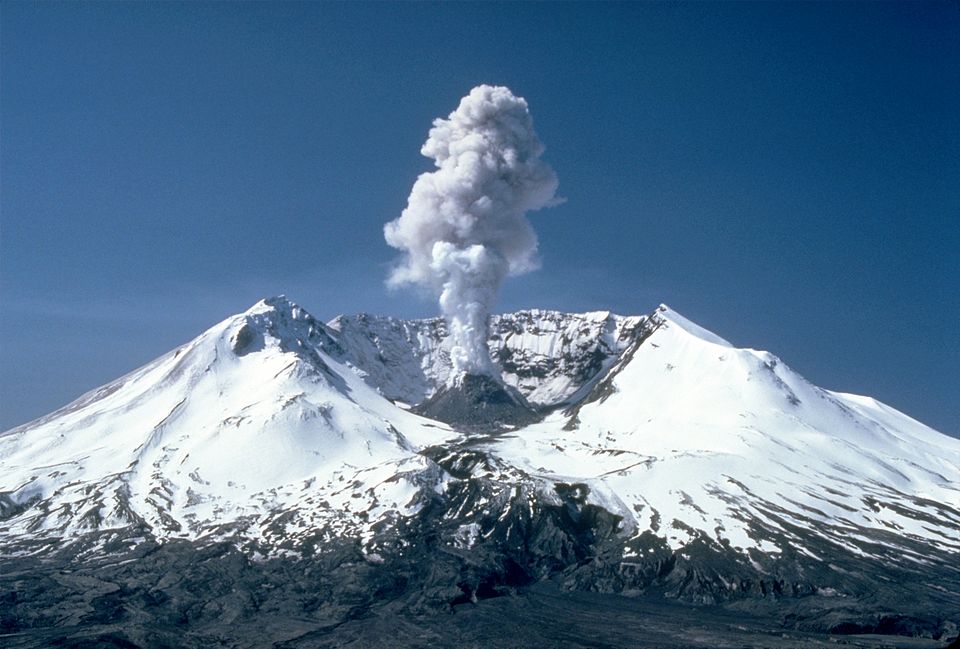
Andesite doesn’t flow quietly. It explodes.
Where basalt oozes from mid-ocean ridges in slow, manageable streams, andesite is the rock of subduction zones — where one tectonic plate is forced beneath another, generating the heat, pressure, and volatile-rich magma that produces the most destructive volcanoes on the planet.
Where It Forms
Key Idea: Andesite is named after the Andes — the mountain chain built almost entirely by subduction-zone volcanism along South America’s western edge.
When oceanic crust subducts beneath continental crust, it carries water and other volatiles down into the mantle. Those volatiles lower the melting point of the surrounding rock, generating magma with an intermediate silica content — roughly 52–63% SiO₂. That’s andesitic magma. More silica than basalt (mafic), less than rhyolite (silicic). That middle ground matters enormously for what happens next.
Higher silica means higher viscosity. Higher viscosity means gas cannot escape easily. Pressure builds. The result is explosive eruption rather than effusive flow.
Composition
Andesite is an intermediate rock — sitting between mafic basalt and silicic rhyolite in the classification scheme. Its minerals reflect that balance:
- Plagioclase feldspar — the dominant mineral, giving andesite its typically grey colour
- Augite — a pyroxene mineral, dark and blocky
- Hornblende — an amphibole, appearing as dark elongated crystals
Key Idea: Andesite has the same overall composition as diorite — the difference is purely texture. Andesite cooled rapidly at the surface (fine-grained). Diorite cooled slowly underground (coarse-grained).
Texture
Fine-grained — crystals are small or invisible to the naked eye because the lava cooled quickly after eruption. Some samples show porphyritic texture: larger crystals (phenocrysts) of plagioclase set in a finer groundmass, indicating two stages of cooling — slow underground, then rapid at surface.
The Volcanoes It Builds
Andesitic magma builds stratovolcanoes — steep-sided, layered cones of alternating lava flows and pyroclastic material. These are the iconic, dangerous volcanoes:
- Mount St Helens, Washington — 1980 eruption removed 400 metres of summit in seconds
- Mount Pinatubo, Philippines — 1991 eruption was the largest of the 20th century
- Soufrière Hills, Montserrat — ongoing since 1995
Key Idea: The 1980 eruption of Mount St Helens was triggered by a flank collapse — a landslide that removed the pressure capping the magma chamber, causing an instantaneous lateral blast. The energy released was equivalent to 1,600 Hiroshima bombs.
Key Terms
{% table %}
- Term
- Definition
- Extrusive Rock
- Rock formed from lava that cooled at the Earth’s surface
- Intermediate
- A rock with 52–63% silica content — between mafic and felsic
- Augite
- A dark pyroxene mineral common in intermediate and mafic rocks
- Hornblende
- A dark amphibole mineral found in intermediate igneous rocks
- Plagioclase Feldspar
- The most common feldspar group; dominant mineral in andesite
- Subduction Zone
- Where one tectonic plate descends beneath another
- Stratovolcanoes
- Steep composite volcanoes built from alternating lava and pyroclastic layers {% /table %}